.webp)
Anthropic's New Model Fable: A Comprehensive Guide
Anthropic's New Model Fable: A Comprehensive Guide
1. Introduction to the Fable Model
1.1 The Vision Behind Anthropic's Latest AI
The AI landscape is rapidly evolving, and Anthropic has significantly raised the bar with the introduction of Claude Fable 5. Released as a 'Mythos-class' AI model, Fable is designed to tackle complex, long-horizon tasks autonomously. Unlike its predecessors, which required extensive prompting and hand-holding, the vision behind Fable is to provide an enterprise-grade AI capable of running independently for days. It bridges the gap between simple conversational agents and fully functioning digital workers capable of profound reasoning.
1.2 Key Architectural Upgrades
Fable 5 boasts an entirely new architectural foundation optimized for high-level software engineering, scientific research, and advanced vision capabilities. One of its most distinctive features is the built-in safety fallback mechanism. Given its raw power in areas like cybersecurity and chemistry, Fable integrates an invisible classifier. If a prompt triggers a high-risk category, the model safely redirects the query to Claude Opus 4.8. Furthermore, Fable features state-of-the-art vision-only processing, recently demonstrated by its ability to complete complex visual tasks using screen captures alone without external APIs.
2. Core Capabilities and Performance Features
2.1 Speed and Processing Efficiency
When it comes to processing efficiency, Fable 5 is an absolute powerhouse for coding and data management. In early benchmarks, Fable successfully migrated a 50-million-line codebase in a single day—a feat that would typically take a massive team of engineers several months. While Fable is highly token-intensive, consuming substantial compute resources for agentic workflows, its output-to-time ratio makes it uniquely efficient for enterprise scaling.
2.2 Advanced Reasoning and Logic
Fable 5 consistently tops the charts on logic and reasoning evaluations. It has demonstrated unprecedented proficiency in complex analytical tasks, scoring the highest among frontier models on Hebbia's Finance Benchmark. The model is also engineered to accelerate drug design, autonomously execute genomics research, and manage vast arrays of unstructured data, showcasing a leap from basic text generation to genuine reasoning.
3. The Difference Between Fable, Opus, and Sonnet
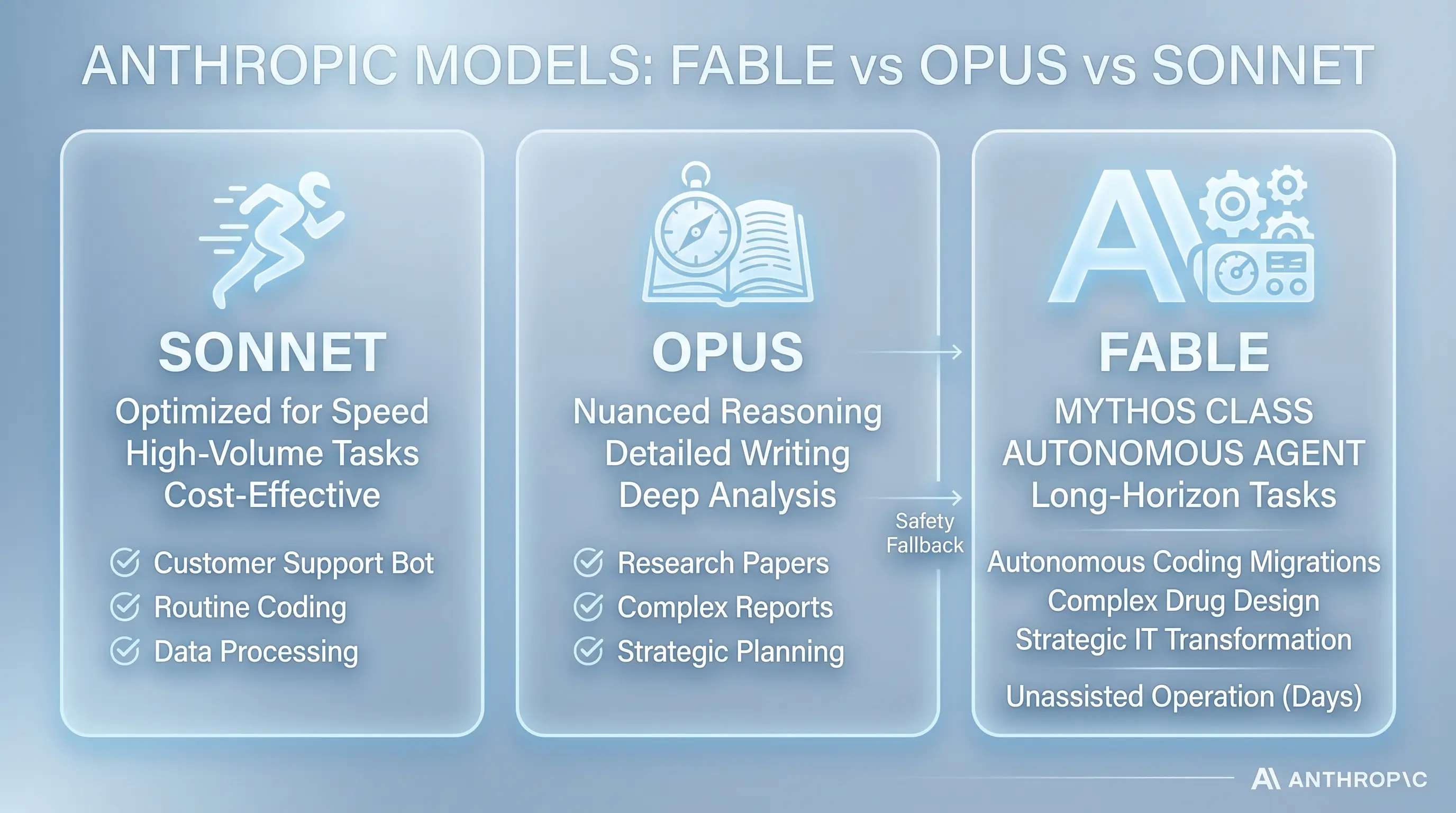
3.1 Model Sizes and Tier Breakdown
Understanding the Anthropic ecosystem requires knowing the differences between its primary models:
- Fable (Mythos-Class): The top-tier, enterprise-level agentic model designed for autonomous, multi-day tasks.
- Opus: The highly capable, balanced model known for excellent reasoning and nuanced writing, now often serving as the safety fallback for Fable.
- Sonnet: The fast, cost-effective workhorse designed for everyday tasks, rapid deployment, and high-volume operations.
|
Feature |
Claude Fable 5 |
Claude Opus |
Claude Sonnet |
|
Primary Use Case |
Autonomous agentic tasks, long-horizon coding, enterprise workflows |
High-level reasoning, detailed writing, safety fallback |
Speed, high-volume repetitive tasks, basic coding |
|
Autonomy |
Can run unassisted for days |
Requires frequent prompt guidance |
Best for immediate, short-turnaround Q&A |
|
Cost per 1M Input Tokens |
$10.00 |
Moderate (Significantly less than Fable) |
Lowest |
|
Cost per 1M Output Tokens |
$50.00 |
Moderate |
Lowest |
|
Vision Capabilities |
State-of-the-art (can navigate UIs autonomously) |
Excellent, but requires more context |
Basic image understanding |
3.2 Feature-by-Feature Comparison
While Sonnet remains the best choice for fast, user-facing applications and chatbots, Opus provides the perfect middle ground for deep analysis without the extreme token burn of Fable. Fable, conversely, is described as a 'bazooka'—extremely powerful but token-hungry, suited strictly for the most complex enterprise logic and IT transformations.
3.3 Anthropic Fable Mythos Model
What is the "Mythos-Class" Architecture?
With the introduction of Claude Fable 5, Anthropic has unveiled a brand-new tier of AI known as the 'Mythos-class.' This tier goes far beyond standard models (like Sonnet or Haiku) because it features a permanent, always-on Adaptive Thinking loop. Instead of just generating text sequentially, the model builds its own execution plans to solve complex problems, cross-verifies its reasoning in real-time, and can operate autonomously for multiple days without human intervention.
The Dynamic Safety Mechanism
Because Fable 5 possesses elite computing and reasoning power, its security guardrails are uniquely sophisticated. Anthropic has integrated a Two-Stage Classifier System. If a user submits a high-risk prompt involving cybersecurity bypasses, biochemical threats, or advanced AI distillation (cloning capabilities), these classifiers detect it instantly. Rather than flat-out blocking the user in these scenarios, Fable 5 automatically routes the query to Claude Opus 4.8 as a safe fallback, ensuring the user still receives a helpful and secure response.
3.4 Fable Model Size
Context Window and Output Scale
Fable 5’s model architecture and scaling mechanisms are purpose-built for massive, enterprise-scale projects. It features a default 1 Million (1M) Token Context Window, enabling it to ingest entire multi-million-line codebases or thousands of pages of financial documents in a single glance. Furthermore, the model can generate up to 128K Output Tokens in a single request, making it fully capable of executing long-horizon software engineering tasks and drafting comprehensive research reports.
Working Memory via Caching & File Tools
A massive context window alone isn't enough; older models often lost track of objectives during prolonged tasks. Fable 5 addresses this limitation by using an active Working Memory combined with File-based Memory Tools. As it works, the model dynamically writes notes to internal scratchpad files and references them as it progresses. Internal benchmarks in gaming and complex logical deductions show that this file-based memory architecture improves Fable's task completion efficiency by up to 3x compared to older Opus models.
4. How to Integrate and Use Fable
4.1 Developer API Access
Developers can access Claude Fable 5 via the Anthropic API. However, due to its immense capabilities, Fable integration requires adherence to strict data compliance policies. Anthropic currently retains prompts and outputs from Fable for 30 days to train its safety classifiers. This has led to temporary restrictions by some enterprise platforms (like GitHub Copilot) while compliance evaluations are underway, so developers must verify their internal data privacy policies before deployment.
4.2 Pricing and Subscription Tiers
Fable 5 is a premium offering. Access via the API is priced at $10 per million input tokens and $50 per million output tokens. For web platform users on Pro, Max, and Team plans, interacting with Fable consumes usage credits at an accelerated rate—often referred to as a '2x usage burn'—due to the dense compute required to process its agentic workflows.
4.3 How to Use Fable Anthropic
Accessing via Developer API and Cloud Platforms
If you are a developer, you can access Claude Fable 5 via the Anthropic Messages API using the model ID claude-fable-5. Beyond the direct API, the model is also deployed across major enterprise cloud ecosystems:
- Amazon Bedrock & Claude Platform on AWS (Initially available in US East and Europe regions).
- Google Cloud Vertex AI and Microsoft Foundry.
Step-by-Step API Integration & Key Requirements
- Configure Data Retention Settings: Before calling Fable 5, you must acknowledge Anthropic's mandatory 30-day data retention policy. You will need to enable the provider_data_share parameter using the Data Retention API, as this model does not fall under standard Zero Data Retention (ZDR) frameworks.
- Setup the SDK and Endpoint: Install the latest Anthropic SDK (Python or TypeScript) and configure your API keys alongside your designated compute engine (e.g., bedrock-runtime).
- Implement Refusal & Fallback Logic: Because Fable 5 features strict active safety classifiers, developers should implement server-side or client-side fallback handlers. If Fable flags and declines a sensitive prompt, your code should automatically route the request to claude-opus-4.8 to ensure uninterrupted service.
Subscription and Credits (Web Interface)
For regular users, Anthropic initially provided access on Pro, Max, and Team plans for early capacity testing, but it now requires premium usage credits. Because of its massive architecture and intense compute requirements, it incurs a 2x usage credit burn compared to standard models. As a result, it is best reserved for highly critical, complex projects rather than everyday casual chat.
5. Frequently Asked Questions (FAQs)
FAQ 1: What exactly is Anthropic's Fable model?
Fable 5 is Anthropic's latest 'Mythos-class' AI model, designed specifically for long-horizon, autonomous tasks in software engineering, scientific research, and complex data analysis.
FAQ 2: How does Fable compare to Opus in terms of capability?
While Opus is highly capable at reasoning and writing, Fable is vastly superior in agentic tasks, meaning it can create a plan and execute it autonomously over a long period. Opus now occasionally serves as a fallback model when Fable triggers a safety restriction.
FAQ 3: Can Fable handle advanced coding and complex mathematics?
Yes. Fable 5 currently holds state-of-the-art scores in agentic coding evaluations like FrontierCode. It has been documented migrating 50-million-line codebases and resolving highly complex architectural tech debt.
FAQ 4: Is Fable faster than Sonnet for high-volume, daily tasks?
No. Sonnet is optimized for speed and cost-efficiency in everyday tasks. Fable is an enterprise-grade model that is 'token-hungry' and slower due to the deep reasoning required for its outputs. Use Sonnet for quick tasks and Fable for massive projects.
FAQ 5: What is the context window size for Fable?
Fable supports an expansive context window (typically scaling alongside previous Anthropic models like 200K+ tokens), but it utilizes its context more efficiently through advanced memory caching, allowing it to hold intricate enterprise data over long sessions.
FAQ 6: How can enterprise users get API access to Fable?
API access is available through Anthropic's developer console and major cloud platforms. However, enterprise users must note the 30-day data retention policy implemented for safety logging before rolling it out to compliance-heavy sectors.
FAQ 7: Does Fable replace any existing Anthropic models?
No, Fable 5 does not replace Opus, Sonnet, or Haiku. It acts as an additional, higher-tier layer for extreme complexity, complementing the existing Claude 3 / 3.5 / 4.x family.